Dr Isobel Romero-Shaw
Ten years ago, on February 11th, 2016, an announcement was made that would revolutionise observational astronomy. Gravitational waves—ripples in the very fabric of space-time—had been directly detected for the first time. This heralded the new era of gravitational wave astronomy, giving us a new ability to “listen” to some of the most cataclysmic collisions in the Universe.
Since the first detection in 2015, the LIGO-Virgo-KAGRA Collaboration has observed hundreds of gravitational-wave signals from the collisions of compact stellar remnants: black holes and neutron stars. And since the first detection, gravitational-wave observations of compact objects have been challenging expectations developed through decades of electromagnetic observations. The most recent gravitational wave transient catalogue, GWTC-4—released in August, 2025—reports 218 signals from merging compact binaries.
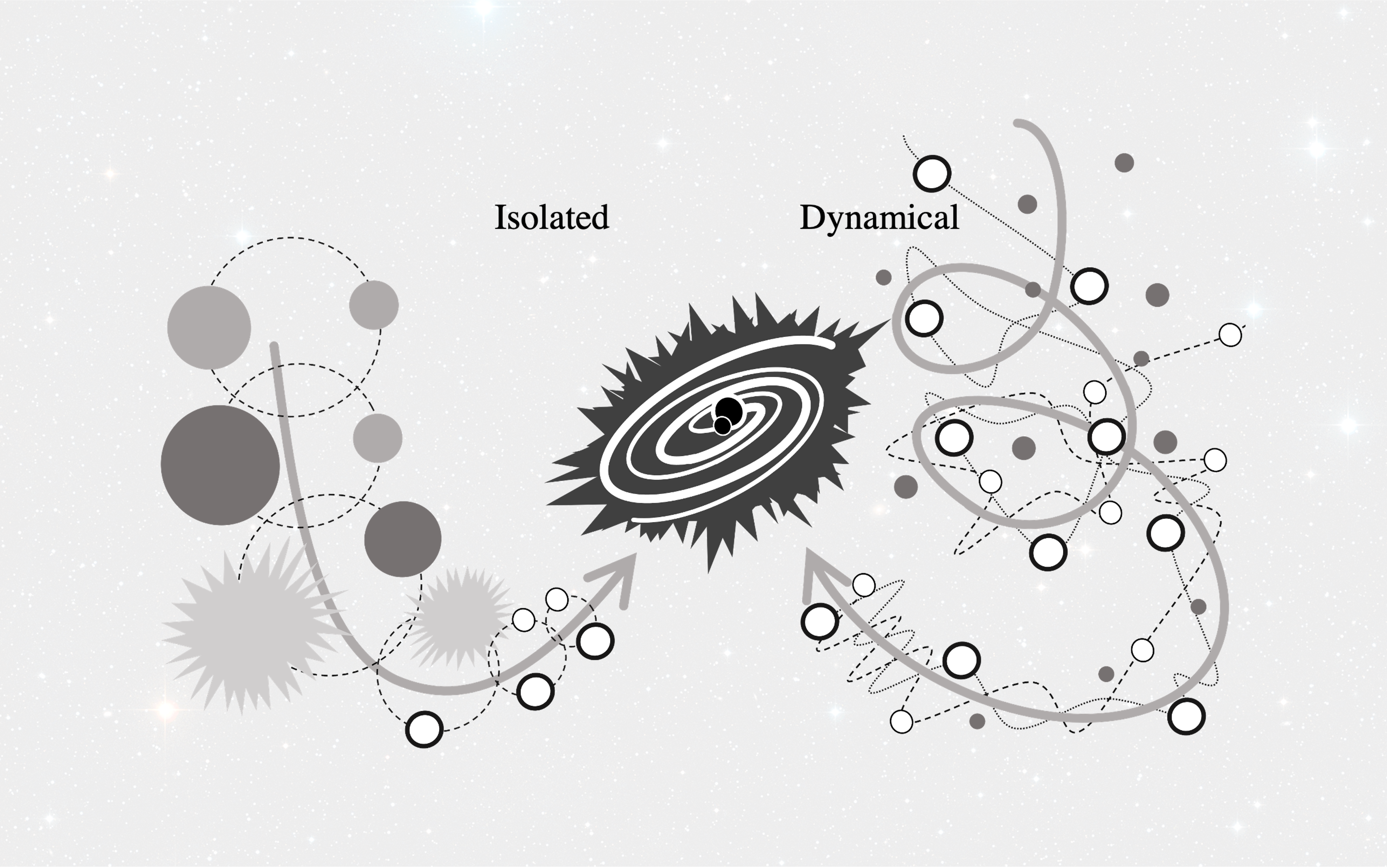
These systems generally have different masses and spins than those observed electromagnetically, and some bear the fingerprints of dynamically-driven evolution.
Gravitational waves carry rich information about their sources: for example, their masses, spins, redshifts, and orbital configurations. These properties, in turn, encode clues about the lives of the binaries---the evolutionary processes they took part in, and the environments in which they reside. In this talk, I will explain how the formation channels that produce colliding compact binaries leave their signature on the properties of the systems we detect. I will demonstrate how gravitational-wave observations so far are reshaping our understanding of stellar evolution, and have shed light on the mechanisms that produce these violent collisions. Finally, I will show how future gravitational-wave detectors will once again revolutionise our view of the Universe with unprecedented sensitivity to low-frequency and high-redshift gravitational waves.