Can AI make fair decisions about who gets asylum? Royal Holloway researchers are finding out.
Imagine being forced to leave your home, fleeing from country to country, until you reach the borders of the UK. You’re seeking a safe place to carry on living your life, but first you must claim asylum.
Every year, thousands of people arrive in the UK fleeing persecution in their home countries, seeking sanctuary and safety. For those hoping to remain, this marks the start of a lengthy and complicated process, one increasingly relying on digital technologies and artificial intelligence (AI). But how do these tools and an understanding of how they work affect the decisions being made? And how do they impact the refugees looking to rebuild their lives?
These are the questions driving the research of psychologists Professor Amina Memon and Dr Zoe Given-Wilson from the Department of Psychology. “We’re trying to have a better understanding of what using these different digital technologies actually means for real-life decisions,” Zoe explains. “The judgements on whether someone is granted protection to stay in the UK or is returned to a country where they fear persecution are life-changing decisions.”
The research
Both researchers specialise in memory and decision-making. Amina explores the complex processes that influence memory and how decisions are made, looking into how they impact asylum claims. She investigates areas such as eyewitness memory and credibility assessment – how a judgement is made on the credibility of a witness testimony. Zoe, a practising clinician, focuses on how trauma affects memory, drawing on her experience working mainly with children and young people in the asylum system.
For them, it’s not just about theory.
“We want to see our work have an impact in the real world,” says Amina.
“We work closely with organisations and charities to share what we find out, supporting refugees to have their claims heard and improve their understanding of the system. And our links with the UK Home Office means we can also influence policy.”
The project
Their latest project - Use of Technology and Artificial Intelligence in Asylum Decision Making – investigates the ethical and practical implications of digital tools in the asylum process.
The change to online interviews during the pandemic, alongside the rapid developments in AI in recent years has resulted in the swift adoption of new digital tools within the asylum system. But there has been little research to understand how these technologies might influence decisions and outcomes that have a real human cost.
“There’s an allure that digital technologies are helping us become more efficient” says Zoe, “but what we’re asking is: for whom, with what conditions and at what cost?”
To explore these questions, Amina and Zoe, together with Professor Jill Marshall in the Department of Law and Criminology, partnered with charities, tech experts, policymakers and people with lived experience of seeking asylum in the UK. Through a series of focus groups, they gathered insights into how digital tools are used in the process. Including the voices of those with lived experience added an invaluable perspective often missing from the debate about technology and asylum.
The outcome
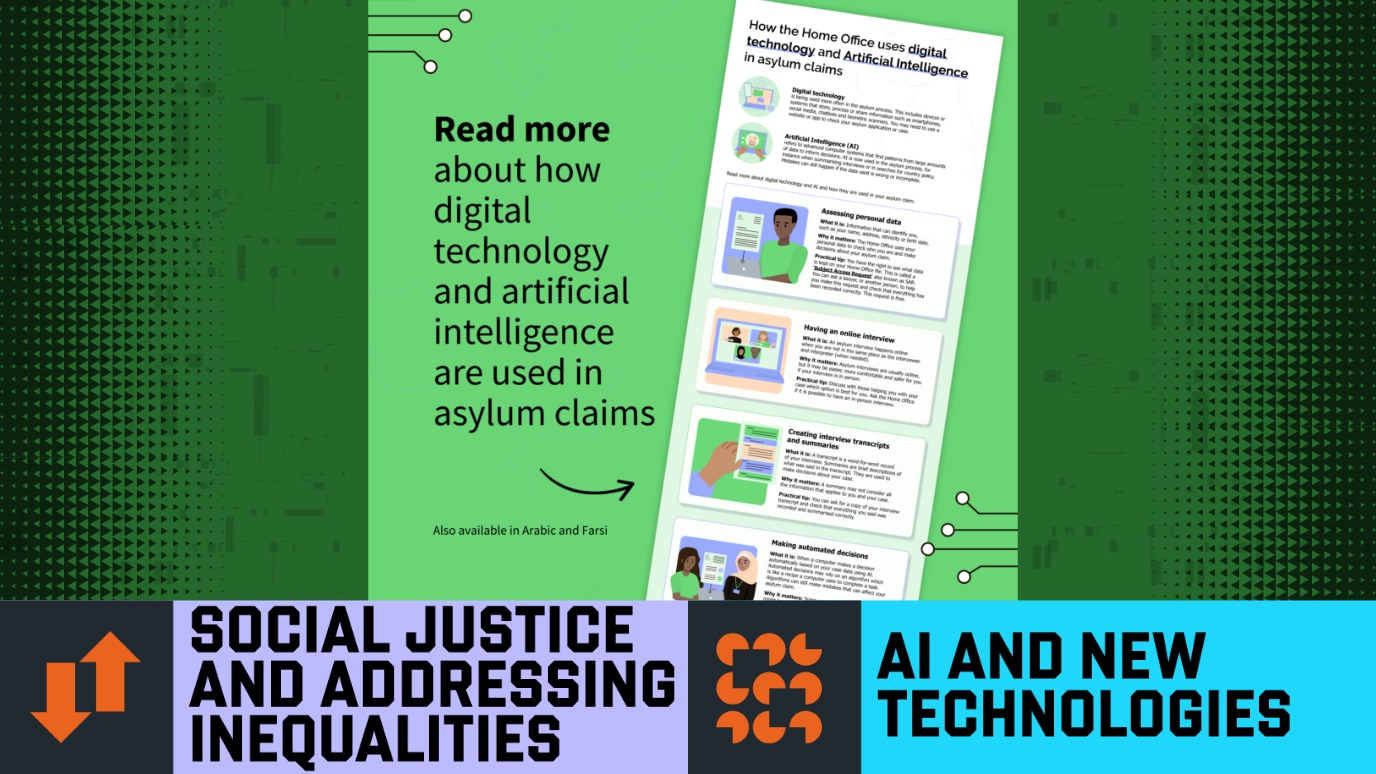
The research team created a new two-page infographic to help people in the asylum process better understand how digital technology and AI is used in asylum claims. Produced in English, it’s been translated into Arabic and Farsi to make it more accessible to a wider audience.
The infographic provides step-by-step guidance to refugees navigating the system and has already been widely distributed to those supporting asylum seekers, through charities and online.
Through their focus on psychological aspects of asylum processes with the Centre for the Study of Emotion and Law, Amina and Zoe’s work can be applied around the world. Their connection to Royal Holloway as a University of Sanctuary supporting displaced students and academics, also strengthens the global relevance of their research. “Despite working in this area for many years, I’m often surprised by the lack of knowledge and understanding about people from different cultural backgrounds, and the assumptions that are made about them,” says Amina.
“By providing psychological insight and including the lived experience of refugees, the research is contributing towards a fairer and more informed asylum process.”
In a system increasingly dictated by technology Amina’s and Zoe’s work is a reminder that at the heart of every claim is a very human story – that should be listened to with empathy, not just efficiency.
You can download a copy of the infographic in English via this link:
Download the infographicFind out more about this project and other work Amina and Zoe are involved with via the links below:
Find out more about CESL’s Projects
Discover more about Psychology at Royal Holloway, University of London via the links below or return to our Research in Focus homepage to uncover more fascinating research taking place at the university.
Research in focus